SELECT LANGUAGE
Showing posts with label The Pilgrimage. Show all posts
Check Availability for Queue Darsan
By booking this, you are not assured with Darshan at Sabarimala. However this entitles you to join the queue at “Nadapanthal” and near to the Pathinettampadi. After verifying your credentials you will be put through the queue for darshan eventually along with those who are waiting in the queue.
This is a free service offered by Kerala Police for the purpose of crowd management at Sabarimala. You are not required to make any payment in this connection.
Please note : We are providing the link only to help our devotees and we are not at all connected with any queue booking and related queries.
Q-Booking
Importants
This facility is provided by Kerala Police as a part of Crowd Management which in turn saves precious time of the Pilgrims.
The print out generated after registration (Q-Coupon) and Identity Card used for registration must be brought while coming for Darshan.
The print out (Q-Coupon) and ID card are to be produced for verification by Police officials.
Children aged below 15 do not require identity card but photograph is essential.
The scanned passport size photograph must be in jpg / jpeg and size below 30 KB.
Females aged between 10 to 50 are not allowed to perform pilgrimage at Sabarimala.
Ensure that JavaScript and cookies of the browser should be enabled before booking.
Mozilla fire fox and chrome browsers are recommended.
Disable Pop-Up Blocker of the browser.
Important Instructions to be followed in Queue Placement Coupon Booking.
This facility is limited, to devotees who are coming to Sabarimala with Irumudikettu.
If the web page is idle for more than 3 minutes the link will get disconnected.
Before you start to register, please ensure that all the items mentioned below are available in your hand.
1) Identity Card.
2) Scanned passport size photo having size less than 30 KB in JPG or JPEG format
This is a free service offered by Kerala Police for the purpose of crowd management at Sabarimala. You are not required to make any payment in this connection.
Please note : We are providing the link only to help our devotees and we are not at all connected with any queue booking and related queries.
Q-Booking
Importants
This facility is provided by Kerala Police as a part of Crowd Management which in turn saves precious time of the Pilgrims.
The print out generated after registration (Q-Coupon) and Identity Card used for registration must be brought while coming for Darshan.
The print out (Q-Coupon) and ID card are to be produced for verification by Police officials.
Children aged below 15 do not require identity card but photograph is essential.
The scanned passport size photograph must be in jpg / jpeg and size below 30 KB.
Females aged between 10 to 50 are not allowed to perform pilgrimage at Sabarimala.
Ensure that JavaScript and cookies of the browser should be enabled before booking.
Mozilla fire fox and chrome browsers are recommended.
Disable Pop-Up Blocker of the browser.
Important Instructions to be followed in Queue Placement Coupon Booking.
This facility is limited, to devotees who are coming to Sabarimala with Irumudikettu.
If the web page is idle for more than 3 minutes the link will get disconnected.
Before you start to register, please ensure that all the items mentioned below are available in your hand.
1) Identity Card.
2) Scanned passport size photo having size less than 30 KB in JPG or JPEG format
Sabarimala Q-Booking Link
Irumudi-Kettu nirackkal
Irumudi can be prepared at the temple at 8:00 am on Special Puja days. Devotees with Irumudi are requested to climb the Holy Steps before 9:00 am and hand over Abhishekam materials to the priest prior to the Abhishekam at 9:30 am
After performing Ayyappa Puja, fill the mudra coconut with melted ghee. If you are a Kanni Ayyappan or Kanni Maalikappuram (first timer), Guruswamy will help you to fill the mudra coconut with ghee. Mudra coconut and other Puja items must be placed in the front pocket of the Irumudi and the other two coconuts must be placed in the rear pocket.
Always keep chanting the names of Lord Ayyappa while preparing the Irumudi. Never place the Irumudi on the floor; always place it on a towel and treat it with Bhakthi.
IRUMUDI ITEMS
Read more
After performing Ayyappa Puja, fill the mudra coconut with melted ghee. If you are a Kanni Ayyappan or Kanni Maalikappuram (first timer), Guruswamy will help you to fill the mudra coconut with ghee. Mudra coconut and other Puja items must be placed in the front pocket of the Irumudi and the other two coconuts must be placed in the rear pocket.
Always keep chanting the names of Lord Ayyappa while preparing the Irumudi. Never place the Irumudi on the floor; always place it on a towel and treat it with Bhakthi.
IRUMUDI ITEMS
|
Sabarimala Periya Paathai Distance Chart
The following table provides details of the distance between key points in the periya paathai. The estimated time is based on the time taken by someone who walks a steady pace.


| From | To | Terrain | Distance | Time |
| Erumeli | Perur Thodu | Tar Road | 3.2 km | 1 hour 15 min |
| Perur Thodu | Top of 2nd Hill enroute Kalaketty | Hilly | 3.5 km | |
| Top of 2nd Hill enroute Kalaketty | Kalaketty | Plains | 7.0 km | 2 hours 30 min |
| Kalaketty | Ariyakudi | Plains | 4.2 km | 1 hour |
| Ariyakudi | Mukkuzhi | Steep Hills | 3.5 km | 1 hour |
| Mukkuzhi | Karivalanthodu | Ups/Downs - Gradual | 8.0 km | 2 hours |
| Karivalanthodu | Karimala Peak | Steep Hill | 5.0 km | 2 hours 30 min |
| Karimala Peak | Periyanavattam | Downhill | 4.75 km | 1 hour 10 min |
| Periyanavattam | Pamba (Cheriyanavattam) | Plains | 2.75 km | 35 minutes |
| Pamba | Sabari Peedam (Neelimala, Appachi Medu) | Steep Hill | 2.75 km | 2 hours |
| Sabari Peedam | Sannidhaanam | Plains | 3.75 km | 1 hour |
| Sannidhaanam | Pull Medu (via Uppupara, Uralkuzhi Theertham) | Steep Hills | 7.75 km | 5 hours 45 min |
1. Erumeli
2. Perur Thodu
3. Kaalaketi
4. Azhutha
5. Azhutha River
6. Kallidumkunnu
7. Inchipparakota
8. Mukkuzhi
9. Karivalam Thodu
10. Karimalai
11. Periya AnaVattam
12. Seriya AnaVattam
13. Pampa Nadi
Accomadation Rates in Sabarimala
ACCOMODATION AT SANNIDHANAM AND PAMBA
The multistoried pilgrim complex is located adjacent to Nadapanthal. There are a few pilgrim shed on the northern side of Pandythavalam and beyond Pandythavalam. Beyond this area a series of public latrines are provided. There is a Government hospital and Ayurvedic Hospital functioning during festival seasons on the south eastern side near the Nadapanthal. Near Malikappuram temple complex there is a dispensary run by NSS. Near the Donor Complex there is a telephone exchange and public hall office with STD facilities.
Rs.50 will be charged extra per additional person for rooms where occupant capacity is mentioned.The multistoried pilgrim complex is located adjacent to Nadapanthal. There are a few pilgrim shed on the northern side of Pandythavalam and beyond Pandythavalam. Beyond this area a series of public latrines are provided. There is a Government hospital and Ayurvedic Hospital functioning during festival seasons on the south eastern side near the Nadapanthal. Near Malikappuram temple complex there is a dispensary run by NSS. Near the Donor Complex there is a telephone exchange and public hall office with STD facilities.
| Guest House | Rate/Room (in Rs.) | PhoneAccommodation Officer/ Guest House Manager |
| PALAZHI (DH I) | 350 | 04735-202049 |
| SOPANAM (DH II) | 350 | 04735-202049 |
| MANIKANTAN (DH III) | 325 | 04735-202049 |
| CHINMUDRA (DH IV) | 325 | 04735-202049 |
| SIVASAKTHI (DH V) | 525 – 975 | 04735-202049 |
| TEJASWINI (DH VI) | 525 | 04735-202049 |
| SREEMATHA (DH VII) | 525 | 04735-202049 |
| PRANAVAM (PC I) | 325 | 04735-202049 |
| SAHYADRI (PC II) | 325 | 04735-202049 |
| KAILAS (PC III) | 200 | 04735-202049 |
| GKD Hall | 900 | 04735-202049 |
| Poorna, Pushkala Hall | 1275 | 04735-202049 |
| Sabari Guest House2 bed3 bed4 bed | 100015002000 | 04735-202056 |
| Forest IB Sabarimala | 200/ bed +50 / each additional | 04735-202074 / 75 |
| Forest Dormitory | 80 / bed | 04735-202074 / 75 |
| Accommodation – Name of building | No.of rooms | Rent/Day (Rs) |
| Pilgrim Centre – I | 134 | 150 to 225 |
| Pilgrim Centre – II | 111 | 250 to 750 |
| Pilgrim Centre – III | 139 | 250 to 750 |
| Donor House No.-I | 24 | 250 |
| Donor House No.-II | 24 | 150 to 600 |
| Donor House No.-III | 24 | 250 |
| Donor House No.IV | 24 | 250 |
| Donor House No.V | 19 | 400 to 750 |
| Donor House No.VI & VII | 24 | 400 |
| Maramath Complex | 22 | 225 to 450 |
| Sabari Nivas Guest House | 64 | 375 to 700 |
| Pamba Guest House | 16 | 300 |
| Cottages (5) | 51 | 600 to 1000 |
| Poorna Pushkala Hall | 1 | 450 |
| Malikappuram Building | 16 | 100 |
Out of the 64 rooms in Sabari Nivas 11 rooms are reserved for VIPs.
For Advance booking for accomodation in Devaswom guest houses contact:
Devaswom Commissioner,
Travancore Devaswom Board,Nanthancode,
Thiruvananthapuram.
Phone: 0471-2315156 , 2316963, 2317983
or
The Accommodation Officer,
Maramoth Complex,
Sabarimala, Kerala
Phone +91-4735-202049
__________________________________________________________________________________
Accomodation at Sannidhanam (Sabarimala) & Pamba
Om Swamiye Saranam AyyappaNote: Rate mentioned may change without notification. We take no responsibility for correctness of the rates mentioned. Please contact Travancore Devasom Board for current rates.
Food Price List
| Sl. No. | FOOD ITEMS | Sannidhanam | Pamba/ Nilackal | Laha/ Thulappally° | Other Regions | Quantity¸ |
1 | Tea | 7.00 | 6.50 | 6.00 | 6.00 | 150ml |
2 | Tea/ Coffee (Without sugar) | 6.00 | 5.50 | 5.50 | 5.00 | ,, |
3 | Coffee | 7.00 | 6.50 | 6.00 | 6.00 | 150 ml |
4 | Instant Coffee | 9.00 | 8.00 | 6.00 | 6.00 | 150 ml |
5 | Horlicks | 12.00 | 11.00 | 10.50 | 9.50 | 200 ml |
6 | Bournvita | 12.00 | 11.00 | 10.00 | 9.50 | 200 ml |
7 | Plain Tea/Coffee | 5.00 | 5.00 | 5.00 | 5.00 | 150 ml |
8 | Dosa (1 No.) | 6.00 | 5.50 | 5.00 | 5.00 | 50 gm. |
9 | Iddali (1 No.) | 6.00 | 5.50 | 5.00 | 5.00 | 50 gm. |
10 | Ghee Roast | 25.00 | 24.00 | 22.00 | 22.00 | 150 gm. |
11 | Masala Dosa | 26.00 | 24.00 | 22.00 | 22.00 | 200gm |
12 | Chappathi (3 Nos. with curry) | 27.00 | 26.00 | 24.00 | 24.00 | 150 gm. |
13 | Poori (3 Nos. with curry) | 27.00 | 26.00 | 24.00 | 24.00 | 150 gm. |
14 | Porotta (1 No.) | 7.00 | 6.50 | 6.50 | 6.00 | 60 gm. |
15 | Parippu Vada | 6.00 | 6.00 | 6.00 | 6.00 | 40 gm. |
16 | Uzhunnu Vada | 6.50 | 6.00 | 6.00 | 6.00 | 40 gm. |
17 | Kadalakkary | 12.00 | 10.50 | 10.00 | 10.00 | 100 gm. |
18 | Peas Masala | 12.00 | 11.00 | 10.50 | 10.00 | 100 gm. |
19 | Kizhangukari | 12.00 | 11.00 | 10.50 | 10.00 | 100 gm. |
20 | Meals (Raw Rice/boiled rice (Standard) Sambar, moru, Pulissery, Thoran, Pickle etc. | 32.00 | 32.00 | 32.00 | 30.00 | |
21 | Kanjii (Payar, Pickle etc | 20.00 | 17.00 | 17.00 | 17.00 | |
22 | Kappa | 14.00 | 14.00 | 14.00 | 14.00 | 350 gm. |
23 | Curd | 8.00 | 7.00 | 6.00 | 5.00 | |
24 | Palappam | 6.00 | 5.50 | 5.00 | 5.00 | 50 gm. |
25 | Idiyappam | 6.00 | 5.50 | 5.00 | 5.00 | 50 gm. |
26 | Vegetable Biriyani | 33.00 | 30.00 | 26.00 | 25.00 | 350 gm. |
27 | Uppumavu (with Vada) | 17.50 | 16.50 | 14.00 | 12.00 | |
28 | Banana fry (Half Ethakka) | 7.00 | 6.50 | 6.00 | 6.00 | 75 gm. |
29 | Bonda | 6.00 | 6.00 | 6.00 | 6.00 | 75 gm. |
30 | Andha Meals | 37.00 | 31.00 | 30.00 | 30.00 | |
31 | Sambharam (Milma) | 5.00 | 5.00 | 5.00 | 5.00 | 200 ml. |
32 | Sambharam (Milma) | 17.00 | 17.00 | 17.00 | 15.00 | 500 ml. |
33 | Curd | 18.00 | 18.00 | 18.00 | 17.00 | 500 ml. |
34 | Milk (Double Toned) | 14.00 | 14.00 | 14.00 | 13.50 | 500 ml. |
35 | Jersey Milk | 15.50 | 15.50 | 15.50 | 15.00 | 500 ml. |
36 | Chappathi (2 Nos. with curry) | 18.00 | 17.00 | 17.00 | 16.00 | |
37 | Poori (2 Nos. with curry) | 18.00 | 17.00 | 17.00 | 16.00 | |
38 | Curd Sadam | 32.00 | 30.00 | 30.00 | 30.00 | |
39 | Lemon Sadam | 32.00 | 30.00 | 30.00 | 30.00 |
Share on Facebook
(Visited 1,211 times, 32 visits today)
KSRTC Bus Fare
Elaborate arrangements have been made by Kerala State Road Transport Corporation (KSRTC) during pilgrim season 2011-2012 to ensure enough and effective sabarimala pilgrimage. A fully equipped bus station including garage facility has started functioning at Pampa round the clock. Buses will be operated from all important bus stations to Pampa and Erumeli.
In addition to Pamba Bus station, there is a temporary bus station at Nilackal. Chain services to Pampa from Nilackal are now operating. Mobile workshop facilities are arranged at Chalakkayam, Pampa, Nilackal, Plappally and Perunad.
KSRTC Bus Fare from Pamba to important destinations 2011-12
KSRTC Tel No Pamba Bus Station - 04735 – 203445
Read more
In addition to Pamba Bus station, there is a temporary bus station at Nilackal. Chain services to Pampa from Nilackal are now operating. Mobile workshop facilities are arranged at Chalakkayam, Pampa, Nilackal, Plappally and Perunad.
KSRTC Bus Fare from Pamba to important destinations 2011-12
KSRTC Tel No Pamba Bus Station - 04735 – 203445
Vazhipaadu Rates
Ancient Hindu sages believed that periodic fasts or vrithams purify the human mind and body. By adhering to an austere way of life and observing tapas in body, mind and speech, man transcends his earthly limitations and changes for the better, so says the Bhagavad Gita. A devotee aspiring for a darshan of Lord Ayyappan has to be pure both mentally and physically and for this, he is expected to observe a mandatory fast (vritham) of 41 days that usually begins on the first day of the Malayalam month of Vrischikam in mid November. A pilgrim who is on his maiden trip to Sabarimala is called a Kanni Ayyapppan.
The 41-days fast highlights the significance of austerity and abstinence in the lives of those seeking a complete merger with the Ultimate. A devotee has to abide by several regulations and dictates if he is to mount the pathinettu padikal and enter the temple on Sabarimala.
The devotee embarks on the 41-day vritham after he gains permission from his parents and Guru. Next, an auspicious day is fixed for the commencement of the vritham and on the eve of the said date, he offers poojas to the family deity and makes a holy knot with yellow cloth containing 1.25 currency units and presents it to the family deity thereby gaining his/her approval to begin the vritham.
The Sacred Mala
As a prelude to the actual pilgrimage, the aspirant wears a beaded mala/garland usually of tulsi or rudraksham to highlight his renunciation of material temptations. Majority of the devotees begin wearing the mala from the first day of Vrishchikam. Wearing the garland on a Saturday or on the day of asterism of Uthram, just prior to the first day of Vrishchikam is considered auspicious, for it is held that Dharma Shastha or Lord Ayyappan was born on first Vrishchikam on a Saturday, the asterism being Uthram. The occurrence of these three features on the same day is a rare phenomenon. Hence any one among the trio is chosen. As a rule the devotee receives his mala from a Guruswami, one who has been to Sabarimala repeatedly several times. The ritual is ordinarily conducted in the precincts of a temple or any other holy place.
As he wears the holy mala around his neck, the pilgrim swears total allegiance to Lord Ayyappan with whom he identifies himself completely. He surrenders his thoughts, words and deeds to the powerful deity and begins to lead the austere life of an ascetic.
On the first day of the fast, the pilgrim awakes early, bathes and offers poojas to the family god, navagrahas (the nine planets) and the holy mala. He then proceeds to the temple with his Guru from whom he receives the mala amidst the chanting of saranams.
Like Lord Ayyappan, the renunciant, the devotee is expected to shun all social activities and immerse himself in prayers, poojas, bajans, visits to the temples, cleaning temples, feeding the poor, attending to the poor/sick and listening to spiritual lectures. Strictly celibate, he consumes only satvic food and is forbidden from having meat, intoxicants like alcoholic beverages, drugs and betel leaves, and smoking.
Taking bath in the pre-dawn hours, regular application of vibhooti, sandalwood paste followed by meditation and singing songs about Lord Ayyappan become his part of his daily routine for 41 days. No shaving is allowed and the devotee prays to Dharma Shastha by chanting his name at least 108 times. He refrains from hurting anybody either physically or verbally and identifies other Ayyappa devotees with the Lord himself. When somebody undertakes the 41-day fast, he must go about it quietly without much ado so as not to cause any inconvenience to his family.
The Ayyappa swami does not oil his hair or body and always carries with him a tulsi leaf to ward off evil and temptations. He sleeps not on the bed and uses no footwear to protect his feet.
Aazhi pooja/Vellamkudi
The Aazhi pooja is an important event associated with the pilgrimage to Sabarimala. It is more or less a celebration that symbolizes the attainment of a renunciant’s frame of mind. The pooja is performed on an auspicious day before the holy trek actually begins. This ritual is also called Vellamkudi, Daham Veppu or Padukka. Vellamkudi in the local Malayalam language means the act of drinking water and Daham Veppu, quenching one’s thirst. Human beings long for satisfaction of their various material desires as a result of their undue attachment to the body. Such unquenched thirsts are impediments in their quest for God-realization; once they are removed, the devotee experiences supreme bliss. By leading a spiritually oriented life for several days, the Ayyappa bhaktha attains a considerable degree of purification, both mentally and physically and this culminates in Aazhi pooja.
A special pandal is erected for this purpose. Fuels for aazhi (fire blaze) are stored in stacks in front of the pandal and camphor is used to start the fire. As the aazhi blazes and tongues of flames go higher, the worshippers circumambulate it chanting ‘Swamiye Saranam Ayyappa.’ Rice flakes, parched rice and pieces of coconut are thrown regularly into the raging fire. The flames are believed to be Lord Ayyappan himself and the articles hurled into the fire represent worldly desires which are annihilated by Lord Ayyappan who is the embodiment of true wisdom. Sometimes, the Ayyappas, ecstatic and oblivious to their surroundings walk on the aazhi, out of devotional fervour.
Soon afterwards, poojas are performed and camphor burnt. Burning of camphor leaves no traces behind; it therefore, connotes total destruction of the meaningless longings of the aspirant.
Kettunira
Another important aspect of pilgrimage to Sabarimala is the preparation of the travel kit which is termed irumudi kettu. Only those who observe the 41-day vritham are allowed to carry it and without the irumudi, the devotee cannot climb the pathinettaam padi at the Sannidhanam. The bag is evocative of Lord Ayyappan’s trip to the forest for tigress’ milk; it has twin pockets, the Munmudi (the front portion) and the Pinmudi (the rear pouch), in addition to an opening in the middle. The pooja articles and offerings to Lord Ayyappan are placed in the front bag while the pilgrim’s personal belongings are packed in the rear pouch.
Irumudi binds the worshipper with the worshipped. It is such a strong tie that the devotee and the devoted are no longer two different entities but a single whole. Munmudi comprises Mudra bags, usually 2 or 3 in number, which hold items for vazhipadu (offering) at the Sannidhanam like:
Coconut filled with ghee for Abhishekam (also called Neithenga), 2 to 4 coconuts (vidalai thengai), Beetel leaves, beetel nut, coins (kanikkappanam), Jaggery (achuvellam), cashewnuts, raisins, dry ginger, poha (thin & thick variety)Cardamoms, dates, honey, avil ( beaten rice), kadhi chakkar, Dried turmeric, turmeric powder, blouse piece, kumkum, vibhooti, sandal paste Sambarani, camphor, agarbathi (incense stick), rosewater,lemon, rice & dal TTT
The front portion of the Irumudi represents the good acts of the devotee and the rear one his sins.
To prepare the ghee coconut (neithenga) for abhishekam, a medium sized coconut is selected. Its outer shell is cleaned and polished using a polishing paper. A hole is made in one eye of the coconut with a pointed instrument to empty the water inside; the opening is then closed with a cork of appropriate size. It is later, filled with ghee during kettunira. The vidalai thenga are broken at regular intervals during the actual pilgrimage – one each at Erumeli and Sharam Kutti and two upon pathinettam padi (the sacred 18 steps at Sabarimala). The jaggery, cashewnuts, raisins, cardamom, honey and dates are used to make Panchamrutam for the Neivedya; with jaggery, dry ginger and cardamom, another neivedya termed panagam is also prepared.
Articles for the pilgrim’s personal use are kept in the pinmudi; these include items for use from the day of commencement of the journey after Kettunira till return. The second bag contains some snacks and other ingredients such as rice and pulses for food that’s prepared during the journey.
It is the Guruswami who prepares the irumudikettu and places it on the head of the devotee. The journey to the Ayyappa temple on Sabarimala is invariably conducted in groups. The traditional route to the shrine covers Erumeli, Kalaketti, Azhutha, Karimala, Pampa and eventually Sabarimala.
The Ayyappa swami who ascends the Patinettampadi 18 times plants a coconut sapling on Sabarimala.
Read more
The 41-days fast highlights the significance of austerity and abstinence in the lives of those seeking a complete merger with the Ultimate. A devotee has to abide by several regulations and dictates if he is to mount the pathinettu padikal and enter the temple on Sabarimala.
The devotee embarks on the 41-day vritham after he gains permission from his parents and Guru. Next, an auspicious day is fixed for the commencement of the vritham and on the eve of the said date, he offers poojas to the family deity and makes a holy knot with yellow cloth containing 1.25 currency units and presents it to the family deity thereby gaining his/her approval to begin the vritham.
The Sacred Mala
As a prelude to the actual pilgrimage, the aspirant wears a beaded mala/garland usually of tulsi or rudraksham to highlight his renunciation of material temptations. Majority of the devotees begin wearing the mala from the first day of Vrishchikam. Wearing the garland on a Saturday or on the day of asterism of Uthram, just prior to the first day of Vrishchikam is considered auspicious, for it is held that Dharma Shastha or Lord Ayyappan was born on first Vrishchikam on a Saturday, the asterism being Uthram. The occurrence of these three features on the same day is a rare phenomenon. Hence any one among the trio is chosen. As a rule the devotee receives his mala from a Guruswami, one who has been to Sabarimala repeatedly several times. The ritual is ordinarily conducted in the precincts of a temple or any other holy place.
As he wears the holy mala around his neck, the pilgrim swears total allegiance to Lord Ayyappan with whom he identifies himself completely. He surrenders his thoughts, words and deeds to the powerful deity and begins to lead the austere life of an ascetic.
On the first day of the fast, the pilgrim awakes early, bathes and offers poojas to the family god, navagrahas (the nine planets) and the holy mala. He then proceeds to the temple with his Guru from whom he receives the mala amidst the chanting of saranams.
Like Lord Ayyappan, the renunciant, the devotee is expected to shun all social activities and immerse himself in prayers, poojas, bajans, visits to the temples, cleaning temples, feeding the poor, attending to the poor/sick and listening to spiritual lectures. Strictly celibate, he consumes only satvic food and is forbidden from having meat, intoxicants like alcoholic beverages, drugs and betel leaves, and smoking.
Taking bath in the pre-dawn hours, regular application of vibhooti, sandalwood paste followed by meditation and singing songs about Lord Ayyappan become his part of his daily routine for 41 days. No shaving is allowed and the devotee prays to Dharma Shastha by chanting his name at least 108 times. He refrains from hurting anybody either physically or verbally and identifies other Ayyappa devotees with the Lord himself. When somebody undertakes the 41-day fast, he must go about it quietly without much ado so as not to cause any inconvenience to his family.
The Ayyappa swami does not oil his hair or body and always carries with him a tulsi leaf to ward off evil and temptations. He sleeps not on the bed and uses no footwear to protect his feet.
Aazhi pooja/Vellamkudi
The Aazhi pooja is an important event associated with the pilgrimage to Sabarimala. It is more or less a celebration that symbolizes the attainment of a renunciant’s frame of mind. The pooja is performed on an auspicious day before the holy trek actually begins. This ritual is also called Vellamkudi, Daham Veppu or Padukka. Vellamkudi in the local Malayalam language means the act of drinking water and Daham Veppu, quenching one’s thirst. Human beings long for satisfaction of their various material desires as a result of their undue attachment to the body. Such unquenched thirsts are impediments in their quest for God-realization; once they are removed, the devotee experiences supreme bliss. By leading a spiritually oriented life for several days, the Ayyappa bhaktha attains a considerable degree of purification, both mentally and physically and this culminates in Aazhi pooja.
A special pandal is erected for this purpose. Fuels for aazhi (fire blaze) are stored in stacks in front of the pandal and camphor is used to start the fire. As the aazhi blazes and tongues of flames go higher, the worshippers circumambulate it chanting ‘Swamiye Saranam Ayyappa.’ Rice flakes, parched rice and pieces of coconut are thrown regularly into the raging fire. The flames are believed to be Lord Ayyappan himself and the articles hurled into the fire represent worldly desires which are annihilated by Lord Ayyappan who is the embodiment of true wisdom. Sometimes, the Ayyappas, ecstatic and oblivious to their surroundings walk on the aazhi, out of devotional fervour.
Soon afterwards, poojas are performed and camphor burnt. Burning of camphor leaves no traces behind; it therefore, connotes total destruction of the meaningless longings of the aspirant.
Kettunira
Another important aspect of pilgrimage to Sabarimala is the preparation of the travel kit which is termed irumudi kettu. Only those who observe the 41-day vritham are allowed to carry it and without the irumudi, the devotee cannot climb the pathinettaam padi at the Sannidhanam. The bag is evocative of Lord Ayyappan’s trip to the forest for tigress’ milk; it has twin pockets, the Munmudi (the front portion) and the Pinmudi (the rear pouch), in addition to an opening in the middle. The pooja articles and offerings to Lord Ayyappan are placed in the front bag while the pilgrim’s personal belongings are packed in the rear pouch.
Irumudi binds the worshipper with the worshipped. It is such a strong tie that the devotee and the devoted are no longer two different entities but a single whole. Munmudi comprises Mudra bags, usually 2 or 3 in number, which hold items for vazhipadu (offering) at the Sannidhanam like:
Coconut filled with ghee for Abhishekam (also called Neithenga), 2 to 4 coconuts (vidalai thengai), Beetel leaves, beetel nut, coins (kanikkappanam), Jaggery (achuvellam), cashewnuts, raisins, dry ginger, poha (thin & thick variety)Cardamoms, dates, honey, avil ( beaten rice), kadhi chakkar, Dried turmeric, turmeric powder, blouse piece, kumkum, vibhooti, sandal paste Sambarani, camphor, agarbathi (incense stick), rosewater,lemon, rice & dal TTT
The front portion of the Irumudi represents the good acts of the devotee and the rear one his sins.
To prepare the ghee coconut (neithenga) for abhishekam, a medium sized coconut is selected. Its outer shell is cleaned and polished using a polishing paper. A hole is made in one eye of the coconut with a pointed instrument to empty the water inside; the opening is then closed with a cork of appropriate size. It is later, filled with ghee during kettunira. The vidalai thenga are broken at regular intervals during the actual pilgrimage – one each at Erumeli and Sharam Kutti and two upon pathinettam padi (the sacred 18 steps at Sabarimala). The jaggery, cashewnuts, raisins, cardamom, honey and dates are used to make Panchamrutam for the Neivedya; with jaggery, dry ginger and cardamom, another neivedya termed panagam is also prepared.
Articles for the pilgrim’s personal use are kept in the pinmudi; these include items for use from the day of commencement of the journey after Kettunira till return. The second bag contains some snacks and other ingredients such as rice and pulses for food that’s prepared during the journey.
It is the Guruswami who prepares the irumudikettu and places it on the head of the devotee. The journey to the Ayyappa temple on Sabarimala is invariably conducted in groups. The traditional route to the shrine covers Erumeli, Kalaketti, Azhutha, Karimala, Pampa and eventually Sabarimala.
The Ayyappa swami who ascends the Patinettampadi 18 times plants a coconut sapling on Sabarimala.
Subscribe to:
Posts (Atom)
۩ Ayyappa DevoteeZ ۩
News Updates
Daily Horoscope
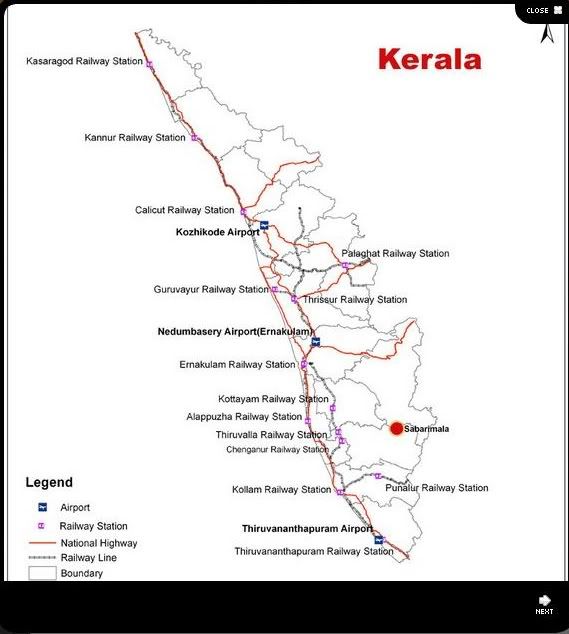
MAP OF SABARIMALA
COMMANDER
Facebook With Us
Divine Followers
Shazta Pancha Ratnam
FEEDBACK ZONE
GATE OF MANTRAZ
Ayyappan Album Songs
Ayyappan Video Songs
News & Alerts
Popular Posts
۩ AYYAPPA DEVOTEEZ ۩. Powered by Blogger.